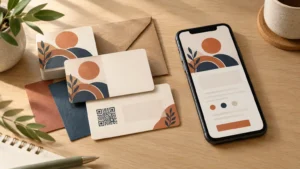
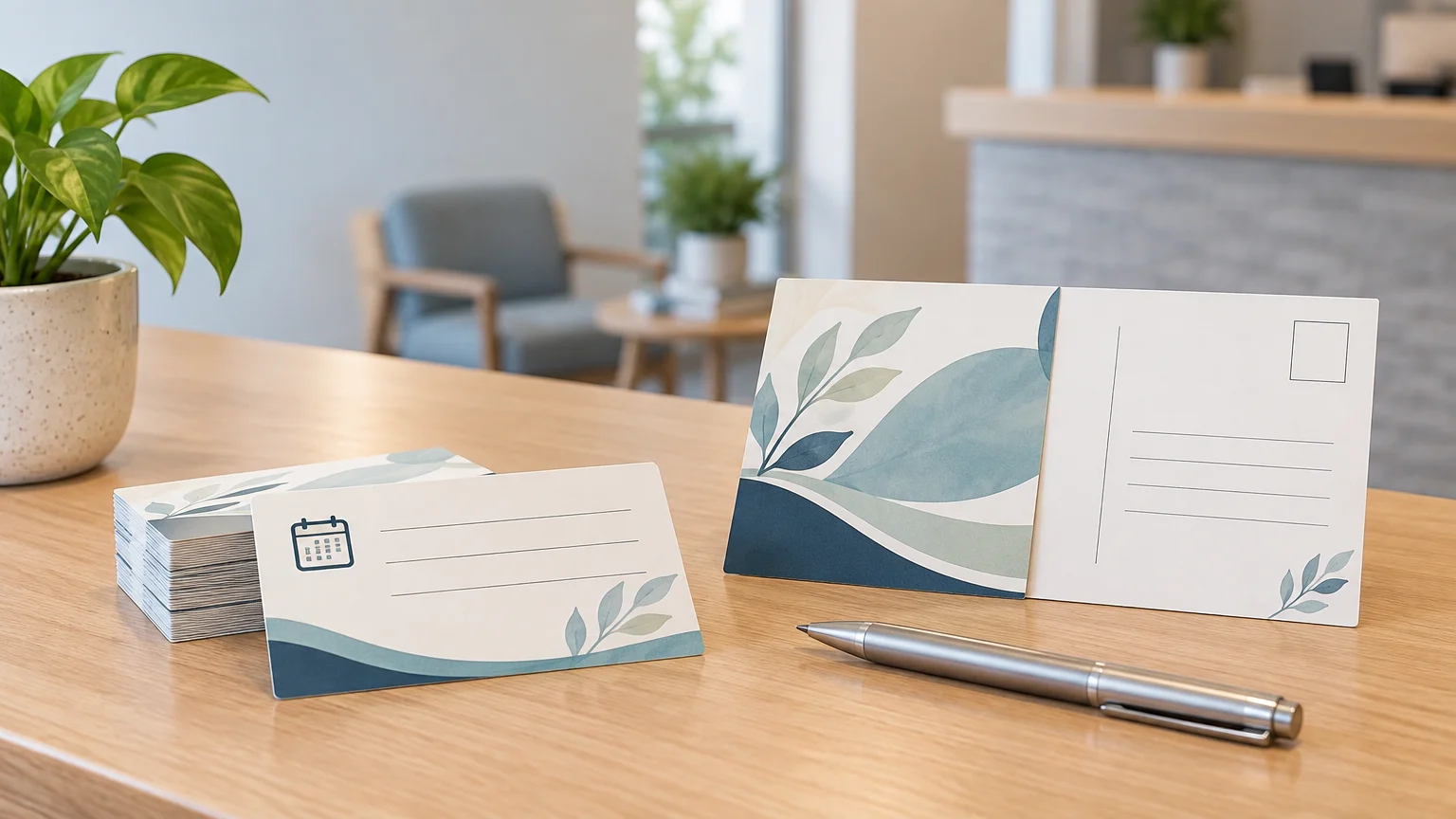
TLDR: Treat dental appointment reminder card printing as two separate jobs. Use a compact, writable card for appointments scheduled at the front desk. Use a larger, privacy-conscious postcard or an enclosed letter for reminders sent through the mail. Decide the delivery method first, then choose the size, content, stock, finish, and artwork.
A reminder card has a small physical footprint but a specific operational job: help the patient retain the practice’s contact information and know what to do next. It should not become a miniature brochure, a treatment summary, and a promotional flyer all at once.
The most useful print plan begins with the handoff. Will staff write on the card and give it to the patient? Will the card be mailed later? Or will it support an existing text, email, or phone confirmation process? The American Dental Association notes that dental practices commonly use phone, email, and text confirmations and advises documenting the patient’s preferred contact method. A printed card can support that workflow without being expected to replace every other channel. Review the ADA’s appointment-confirmation guidance.
Dental appointment reminder cards serve two different workflows
| Print piece | Primary job | Useful characteristics | Main risk to manage |
|---|---|---|---|
| Front-desk appointment card | Give a patient a portable record of a scheduled visit | Compact size, writable surface, clear contact details | Handwritten information that smears or becomes hard to read |
| Mailed reminder or recall postcard | Prompt the patient to contact the practice or remember a scheduled visit | Address area, postage space, discreet wording, readable call to action | Exposing unnecessary health or treatment information |
| Reminder sent in an envelope | Carry information that should not appear on an exposed postcard | Private enclosure, room for instructions, flexible page size | Higher material and mailing complexity |
Do not send the front-desk design directly to a mailing list without reviewing it. A handout can use both sides for appointment fields, branding, directions, and contact information. A mailed postcard must also accommodate the recipient address, return address, postage treatment, and postal clear zones. Its exposed message needs an additional privacy review.
Plan a compact, writable card for the front desk
A business-card format is a practical starting point for a handout because it fits in wallets and card holders. As one vendor-specific example, PrintPlace lists 2 by 3.5 inches as its standard business-card size and identifies a 14-point uncoated stock as writable. Those details illustrate an available configuration, not a universal rule or a Prints Jackson product specification.
The useful decision is not whether the card has the glossiest finish. It is whether staff can write the appointment date and time quickly with the pens available at the desk. A glossy or heavily coated writing area may cause some inks to smear, skip, or dry slowly. An uncoated card is the straightforward choice when most details will be handwritten. Another option is a coated front for visual presentation and an uncoated or intentionally writable reverse, if the printer offers that combination.
Before ordering a full quantity, request or produce a small proof and test the actual writing tools used by staff. Write a sample date and time, handle the card immediately, and put it into a wallet. This simple check is more relevant than choosing a finish from a screen preview.
Give every field a clear job
A front-desk card normally needs only the information required to recognize the practice, retain the appointment, and contact the office. A workable hierarchy is:
- Practice name and phone number in a prominent position.
- Appointment date and time fields with enough room for normal handwriting.
- A neutral instruction such as “Please call if you need to reschedule.”
- Website, patient portal address, or scheduling QR code when it leads to a useful action.
- Office address when patients may need directions or the practice has multiple locations.
- A brief arrival instruction only when it applies consistently to most recipients.
Keep the handwritten fields away from trim edges, decorative patterns, and dark photographs. If a field requires tiny handwriting to fit, the field is too small. The phone number should remain usable even when the card is viewed quickly rather than studied under ideal lighting.
A QR code can be helpful when it opens directions, contact options, or an approved scheduling page. Give the patient a reason to scan it with a short label such as “Get directions” or “Manage your appointment.” A mystery square is not a call to action. Keep a readable phone number or web address as a fallback rather than making the code the only route forward.
Build mailed recall cards around the postal layout
If the reminder will travel without an envelope, select the mailing format before designing the artwork. USPS states that a retail First-Class Mail postcard must be rectangular, at least 3.5 inches high by 5 inches long by 0.007 inch thick, and no larger than 4.25 inches high by 6 inches long by 0.016 inch thick. A larger piece may still be mailable, but it can be charged at letter pricing rather than postcard pricing. Verify the current requirements through the USPS postcard-size guidance before approving the order.
Leave enough room for the address and postage arrangement required by the selected mailing process. Ask the printer or mailing provider for its current template rather than drawing the address panel from memory. If the design includes magnets, labels, stickers, tabs, or other attachments, obtain a mailability review first; USPS warns that attachments can affect whether a piece qualifies or can be mailed as planned.
A mailed recall card does not always need a specific appointment date. It can instead use neutral language asking the recipient to contact the practice. That approach may fit a general recall workflow, but the final wording should reflect the purpose of the communication and the practice’s approved procedures.
Use discreet wording on anything exposed in the mail
Privacy review is a content decision, not a paper-stock feature. Avoid describing a mailed piece as a “HIPAA-compliant postcard.” Appropriate handling depends on the message, the practice’s policies, patient communication requests, and applicable requirements.
The ADA advises discretion in appointment reminders. It indicates that a patient’s name with an appointment date and time is generally acceptable, while references to treatment, a condition, or pre-medication can create concerns when another person might see or hear the reminder. HHS also addresses appointment reminders within its HIPAA privacy guidance, while promotional content or additional third-party activity may call for a different analysis than a straightforward care reminder.
For an exposed card, keep the wording neutral. Avoid listing procedures, diagnoses, medications, balances, insurance issues, or other details that reveal more than the reminder requires. If the communication needs sensitive instructions, an envelope or an approved secure channel may be a better format. Have the practice’s privacy or compliance lead approve the wording and process before printing.
Prepare artwork for fast reading and reliable production
Appointment cards are handled at close range, but that does not justify cramped type. Establish a clear reading order: practice identity, appointment information or reminder message, then contact action. Use strong contrast and reserve decorative elements for space that does not compete with writable fields, mailing areas, or instructions.
Build the file to the printer’s exact template, including the finished size, bleed, and safe area. Extend background colors or images through the bleed when they are intended to reach the edge, but keep phone numbers, QR codes, appointment fields, and other essential content inside the safe area. The print-ready file preparation guide explains the broader checks for size, bleed, resolution, and color setup.
PrintPlace’s current catalog includes business cards and postcards, demonstrating that both general product categories are commercially available. Stock selections, quantities, templates, turnaround times, mailing options, and prices are vendor-specific and can change, so verify them on the chosen supplier’s live product page when ordering. If local support or physical samples matter, use a consistent checklist when evaluating a local print shop rather than comparing headline prices alone.
Use an approval checklist before placing the order
- Confirm whether the piece is a front-desk handout, mailed postcard, or enclosure.
- Check the final dimensions against the printer’s current template.
- Verify that every handwritten field is large enough and uses a writable surface.
- Test the card with the pens staff will use.
- Confirm the practice name, address, phone number, website, and QR destination.
- Review spelling, dates, office hours, and rescheduling instructions.
- Remove unnecessary treatment or health information from exposed wording.
- Obtain internal privacy or compliance approval for mailed reminder content.
- Confirm the address panel, postage area, and current postal classification.
- Review a physical or digital proof at actual size, not only while zoomed in.
- Order a quantity that can be used before contact details, branding, or procedures change.
- Confirm production turnaround and shipping separately from the date the cards are needed.
Control versions so old cards do not linger
Appointment cards often become stale because a phone number, location, web address, or scheduling process changes while boxes of old cards remain in drawers. Add a small internal version code or revision date to the artwork. It does not need to attract patient attention; it only needs to help staff distinguish the current card from an obsolete one.
Keep one approved master file and record the finished size, stock, finish, quantity, printer template, and approval date. When reordering, verify the information and QR destination instead of clicking “reorder” automatically. For multiple locations, separate the files clearly and avoid relying on nearly identical filenames.
Choose the workflow before choosing the finish
For a front-desk handout, start with a compact card, generous appointment fields, and a reliably writable surface. For a mailed reminder, start with the current postal format, address layout, neutral wording, and internal privacy approval. Use an envelope when the message requires details that should not be exposed.
The practical next step is to write a one-page production brief covering recipient, delivery method, desired action, required fields, privacy reviewer, finished size, stock, quantity, and deadline. Once those decisions are settled, dental appointment reminder card printing becomes a controlled workflow rather than a last-minute stationery order.
References
- Appointment Confirmations | American Dental Association
- Business Cards – Print in Standard or Custom Sizes | PrintPlace
- Sizes for Postcards | Postal Explorer
- HIPAA 20 Questions | American Dental Association
- Standards for Privacy of Individually Identifiable Health Information | HHS.gov
- Online Printing Company – Offset, Digital and Large Format Printing Services – PrintPlace